01
Scope the incident
Choose the exact Slack channels, time window, threads, and reviewer. Nothing is searched in the background.
Evidence-first incident review
OnRecord turns fragmented Slack conversations into a source-linked postmortem your team can verify, revise, and stand behind.
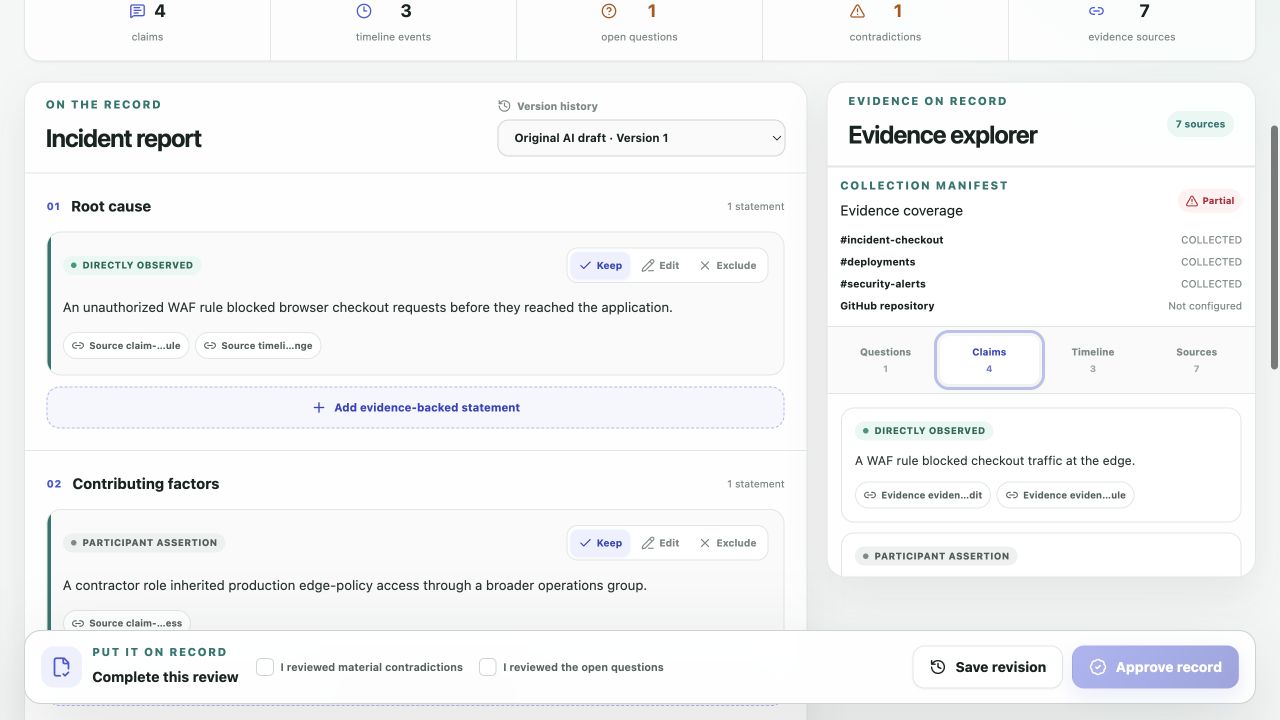
An unauthorized WAF rule blocked checkout requests at the edge.
How was the authenticated session acquired?
The dangerous part isn’t the blank page
During an incident, observations sit beside guesses. Decisions are buried between status updates. Contradictions arrive out of order.
A conventional AI summary smooths that mess into fluent prose. OnRecord does the opposite: it preserves the seams, so a reviewer can see why every conclusion exists.
The actual review workspace
The window beside this copy loads the same React application used by the authenticated review console. The public demo swaps only the API boundary for validated synthetic state.
90-second product walkthrough
Recorded in a connected test environment with synthetic incident data. Processing and review sequences are visibly accelerated; the approval and publication path is real.
From signal to record
No autonomous diagnosis. No one-prompt postmortem. No silent upgrade from “maybe” to “fact”.
Choose the exact Slack channels, time window, threads, and reviewer. Nothing is searched in the background.
Messages become cited timeline events, claims, contradictions, and questions—not a loose prompt transcript.
Keep, edit, exclude, or reclassify each statement while the source evidence stays beside it.
Only a human-approved immutable revision can be published to Confluence or Notion.
Show the work
“Implemented” means code and tests exist. It does not mean a customer environment has already been provisioned.
Slack intake
A signed Slack shortcut opens a bounded scoping flow: time window, one primary public channel, up to four additional public channels, optional thread anchors, and a named reviewer.
Implemented · requires connected SlackEvidence pipeline
Collection is checkpointed. Analysis persists cited timeline events, claims, contradictions, questions, source coverage, model metadata, and token usage before report generation begins.
Implemented · synthetic demo dataHuman review
The public demo is a production build of the real review console—not a marketing recreation. Only its API boundary is replaced with validated, in-memory synthetic incident data.
Live in this demoControlled publication
Approval locks one immutable revision and queues retry-safe publication through configured Confluence or Notion adapters, followed by a final Slack notification.
Implemented · external effects disabled hereCapability ledger
Code and focused automated tests exist in the product repository.
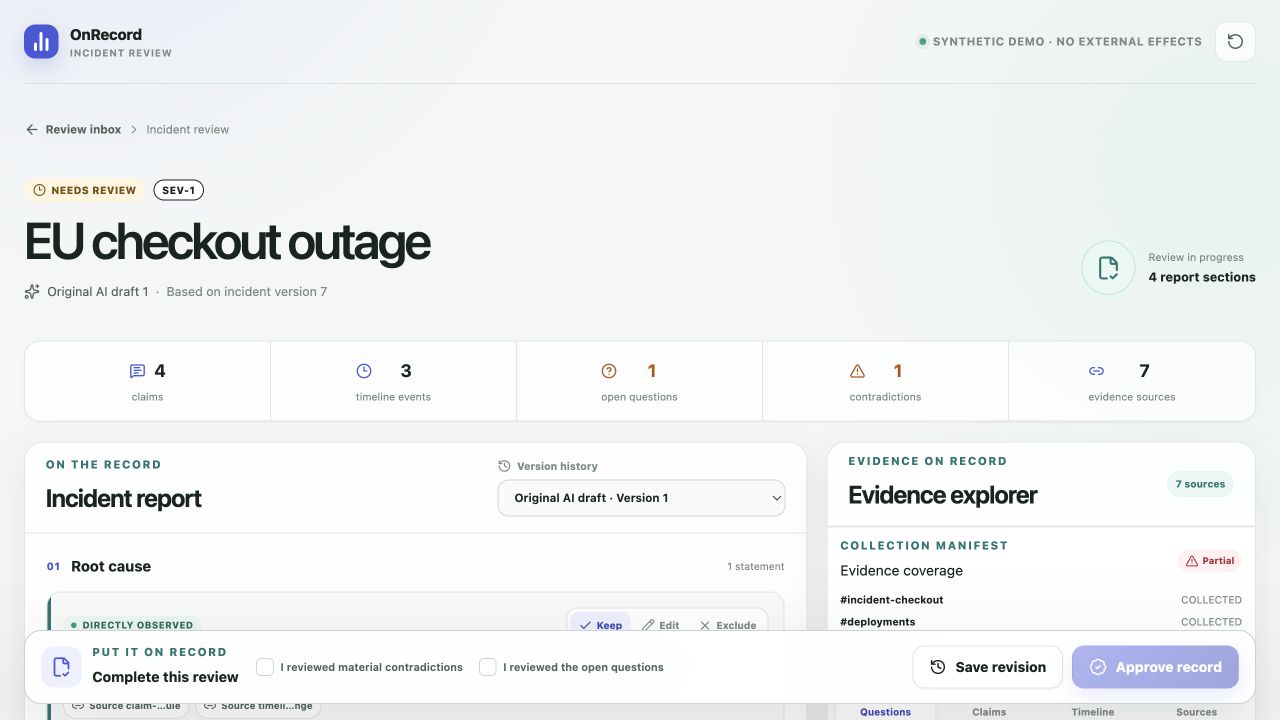
The production review UI runs against constrained synthetic state.
Implemented paths that still require a provisioned customer environment.
Explicit roadmap—not represented as available product functionality.
Capability status reflects the repository as of July 2026. The public demo never connects to customer systems or publishes externally.
Live system journey
The moving packet follows the implemented production path. It pauses at the human gate because infrastructure can prepare a record, but it cannot approve one.

Raw signed HTTP request

Public webhook boundary

HMAC + replay verification

Durable, deduplicated command
Idempotent incident start

Deterministic orchestration
Bounded Slack history pages
Approved channels + threads

Atomic PostgreSQL checkpoints
OpenAI structured extraction
Source-linked draft + validation
Content-free review-ready link


S3 origin through CloudFront

Authorization code + PKCE
JWT + membership authorization
PostgreSQL transaction + outbox

Bounded publication schedule
Leased, retry-safe side effects


Confluence or Notion + Slack
Secrets Manager supplies scoped runtime credentials to the relevant Lambdas and is intentionally shown outside the event path: secrets configure execution; incident payloads do not travel through it.
The implementation stack
These technologies are present in the repository. Customer infrastructure still requires explicit provisioning.
 React 19
 TypeScript
 TanStack Query
 Radix UIAmazon Cognito
 OpenAI Responses API
 Zod schemasPostgreSQL
 AWS Secrets ManagerAPI GatewayAWS LambdaSQS FIFO + DLQStep FunctionsEventBridgeAmazon S3CloudFront
 Terraform
 GitHub ActionsConfluenceNotion
Brand marks identify the technologies used; they do not imply vendor endorsement. AWS service artwork is from the current AWS-approved architecture icon set.
Trust is a product behaviour
The draft is generated from structured, cited claims—not directly from raw conversation.
Hypotheses, disputes, partial coverage, and unanswered questions cannot be polished away.
The model cannot confirm a cause, approve a revision, or create an external effect.
Built with tenant-scoped authorization, immutable revisions, bounded model access, retry-safe publication, and source-content-free operational logs.
Human approval requiredSynthetic incident. Production interface.
Review the evidence, challenge the draft, and put one revision on the record.
Enter the demo